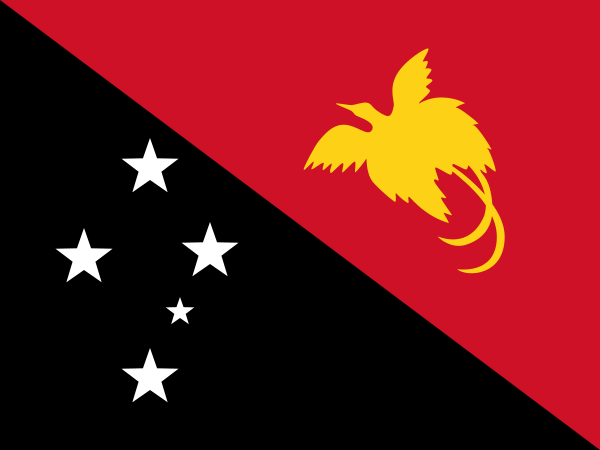
Papua New Guinea — Country Profile & National Debt
An overview of Papua New Guinea covering geography, demographics, economy, culture, political status, and practical information, sourced from World Bank and REST Countries open data.
These figures are estimates based on public statistics and may differ from actual values.
About Papua New Guinea
The capital of Papua New Guinea is Port Moresby. It has a population of approximately 10.6M. The country covers an area of 462,840 km². It is located in Melanesia.
Has the highest number of spoken languages in the world (around 840).
Geography
Papua New Guinea is a country in Melanesia, part of the Oceania region. It covers an area of approximately 462,840 km². It shares land borders with Indonesia, totalling 1 neighbour.
Demographics & Languages
Papua New Guinea has a population of approximately 10,576,502 people. Population density is around 22.9 people per km². Its officially recognised languages include English, Hiri Motu, and Tok Pisin, totalling 3 languages. People from this country are referred to as Papua New Guinean.
Economy Overview
As of 2025, Papua New Guinea reports a nominal GDP of about $32.5 billion. Government debt stood at roughly 52.0% of GDP in 2024. The official currency is the Papua New Guinean kina (PGK, symbol K). The current exchange rate is approximately 1 USD = 4.46 PGK.
Culture & Time
Papua New Guinea operates on a single time zone (Pacific/Port_Moresby). Its country-code top-level domain (ccTLD) is.pg.
Government & Status
The capital of Papua New Guinea is Port Moresby. It is internationally recognised as an independent sovereign state. The country is a member state of the United Nations.
Practical Information
Traffic drives on the left. The international dialling code is +675. Its ISO 3166-1 alpha-2 code is PG.
Data Sources & Methodology
GDP and debt-to-GDP figures on this page are pulled from the most recent available year of World Bank open statistics. The real-time debt estimate is computed by multiplying total debt (GDP × debt ratio) by World Bank's real interest rate (or a 4% fallback when unavailable) and dividing across each second of a year. Exchange rates refresh hourly via open.er-api.com, and country-level metadata such as languages, time zones, borders, and domains is fetched from REST Countries every 24 hours. All values are estimates derived from public datasets and may differ from official figures.